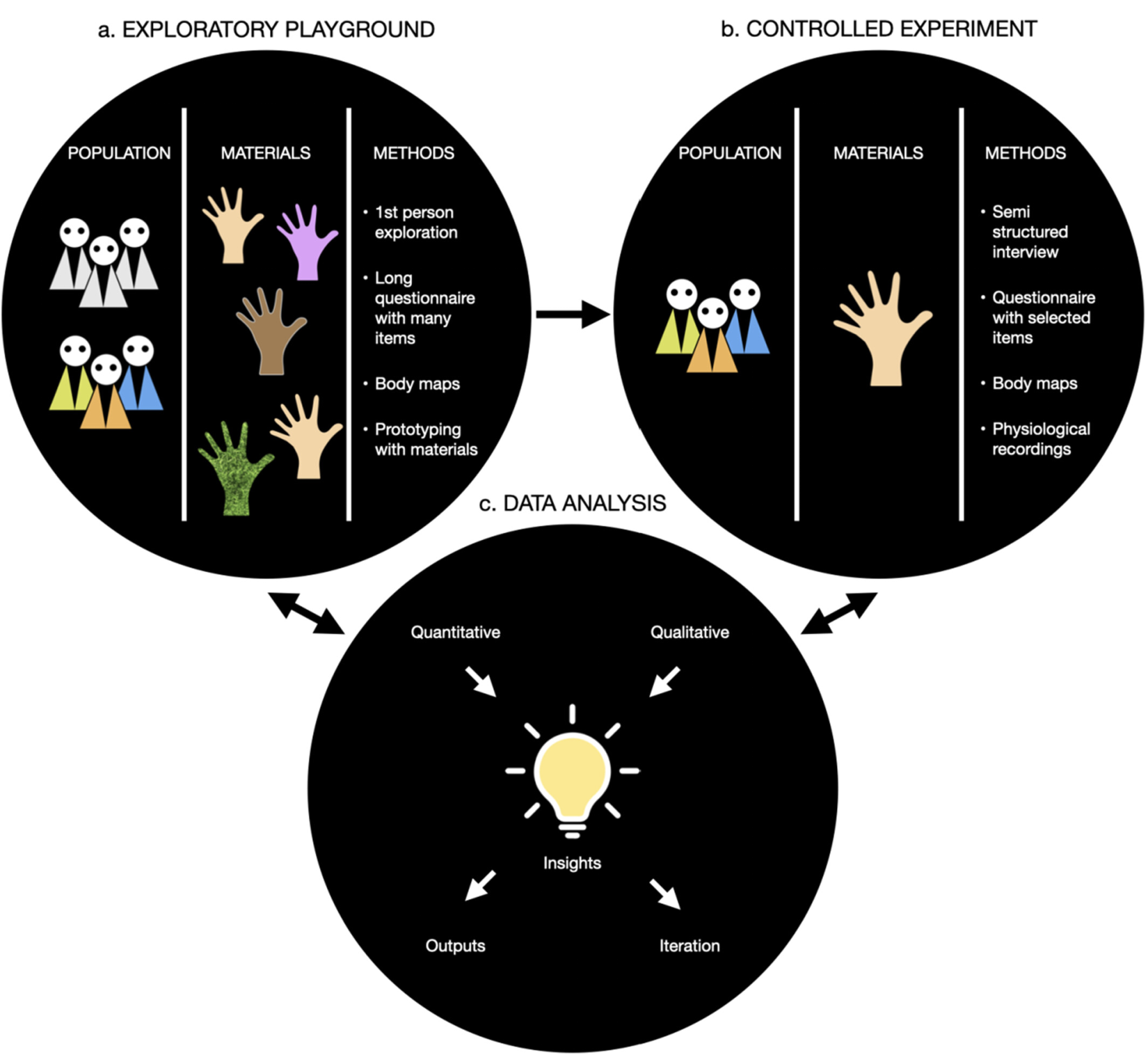
BeAnotherLab member Marte Roel Lesur just published this article on the integration of quantitative and qualitative methodologies in experimental psychology and cognitive neuroscience, in particular in the study of body perception.
This is an approach that we’ve worked hard to push forward at BeAnotherLab. Through the experimentation afforded by artistic practices, we’ve been able to design unique mind altering experiences that bring a wealth of embodied and situated knowledge to the lab, while being often inaccessible through conventional experimental designs alone. Through workshops, installations, and participatory formats, we have created what the article frames as “exploratory playgrounds”: spaces where participants actively engage with altered bodily experiences, generating rich first-person accounts, unexpected insights, and new research questions. These processes have helped reveal both the limitations of purely quantitative paradigms for inducing strong phenomenology and the potential of integrating more situated, qualitative forms of knowledge into scientific inquiry.
By bringing these perspectives into the laboratory, the authors aim to expand the methodological toolkit of cognitive science. Integrating qualitative insights such as first-person accounts, body mapping, and open-ended exploration alongside physiological and behavioral measures allows for a more comprehensive understanding of how people experience their bodies, and is already part of how we run collaborative workshop in interdisciplinary research in-the-wild for many years, often outside of academic contexts.
This integrated approach already informs how we conduct collaborative, interdisciplinary research in-the-wild, often beyond traditional academic contexts, while continuing to explore how such methods can be further developed and connected to quantitative frameworks.
If you find this idea compelling, please read the article following this link and don’t hesitate to get in touch with BeAnotherLab!
Previous PostScène Nationale de l'Essonne - Évry
Next PostEmbodied Virtual Reality: Redistributing Narrative Power in Contexts of War and Displacement